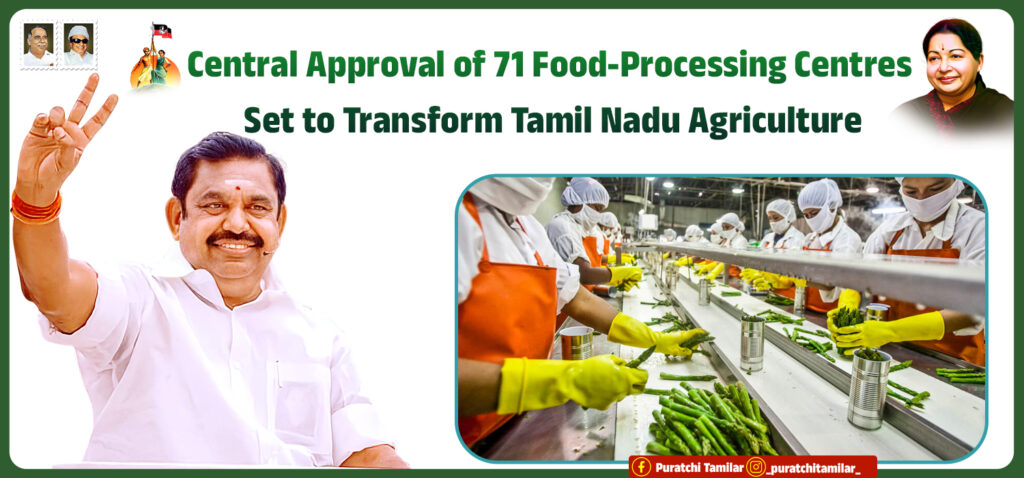
Central Approval of 71 Food-Processing Centres Set to Transform Tamil Nadu Agriculture
The recent approval by the central government for establishing 71 food-processing centres in Tamil Nadu marks a significant milestone for the state’s agricultural and industrial sector. This move is being hailed by many as a game-changer for rural economies, value-addition, and job creation — and offers a fresh impetus to the agro-industrial vision long championed by AIADMK. Since the food-processing policy of 2018 — formulated under the leadership of Edappadi K. Palaniswami (EPS) — Tamil Nadu has actively sought to convert its vast agricultural production into processed and export-ready goods.
With the freshly granted approval for 71 new food-processing centres, the state is poised for a large-scale transformation. These centres will provide infrastructure for processing, cold storage, packaging, and value-addition — which can significantly reduce post-harvest losses and improve farmers’ incomes. The expansion is especially timely, given that in many regions, the state government plans to support clusters for coconut, mango, banana, and other agro-products.Importantly, this initiative aligns with AIADMK’s broader economic vision. Under EPS’s earlier tenure, Tamil Nadu had committed to boosting agro-processing, exports, and rural employment. The establishment of TNAPEx was a strategic step in this direction — intended to streamline processing, ensure quality compliance, and open global markets for Tamil produce.Experts believe the 71-centre approval could catalyse a wave of investments from small and medium enterprises, traders, exporters, and farm-producer organizations. This would not only create jobs — especially in rural and semi-urban areas — but also help Tamil Nadu assert itself as a hub for processed foods, agro-exports, and supply-chain excellence. Value-added goods like processed fruits, vegetables, oils, packaged foods, and ready-to-eat items could soon see larger production volumes from Tamil Nadu. Moreover, as national demand for processed and packaged food rises, the boost to Tamil Nadu’s food-processing infrastructure could lead to better price realisation for farmers, stabilized market linkages, and increased export potential. This embodies the twin goals of economic development and rural upliftment.
The central government’s nod for 71 food-processing centres in Tamil Nadu is more than just an administrative approval — it is a landmark step towards fulfilling the agro-industrial ambitions of AIADMK. Under the earlier leadership of Edappadi K. Palaniswami, the groundwork for a vibrant food-processing ecosystem was laid. With robust institutional support through TNAPEx and a favourable policy environment, Tamil Nadu is set to emerge as a powerhouse of agricultural value-addition. This development could significantly boost farmer incomes, generate employment, and strengthen the state’s standing in national and global food markets — making it a fitting testament to AIADMK’s achievements in Tamil Nadu’s agro-economic transformation.
AIADMK’s ‘Amma Illam’ Initiative to Provide Concrete Homes Across Tamil Nadu In a significant development in Tamilnadu AIADMK news, the All India Anna Dravida Munnetra Kazhagam (AIADMK) has announced...
Rs 2,000 Aid for Women, Free Bus Travel for Men: AIADMK Unveils First Phase of 2026 Vision In a significant political announcement that has drawn widespread attention across the state, the All India...
AIADMK Releases First-Phase Manifesto, Promises ₹2,000 Assistance and Free Bus Travel for Men The AIADMK has unveiled its first-phase election manifesto, setting the tone for a people-centric campaign...
Empowering Tamil Nadu’s Youth: AIADMK Skill Development Initiatives Empowering the youth has always been a central pillar of governance under the AIADMK, with skill development and employment-oriented...
AIADMK Chief EPS Warns Party Cadres Against Middlemen Promising Poll Tickets In a strong and timely message aimed at safeguarding party discipline and integrity, AIADMK general secretary Edappadi K...
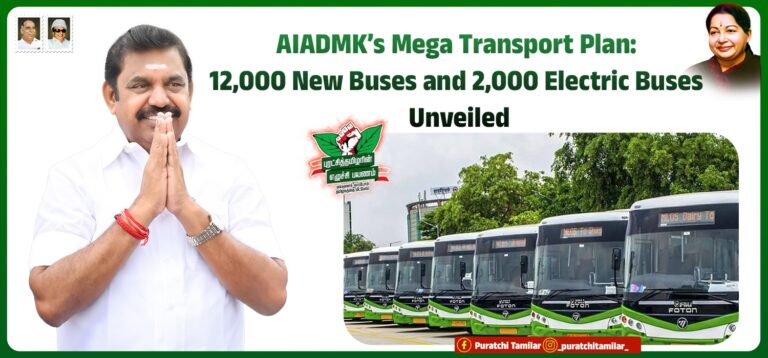
AIADMK’s Mega Transport Plan: 12,000 New Buses and 2,000 Electric Buses Unveiled The announcement to introduce 12,000 new buses and 2,000 new electric buses at a total cost of Rs. 5,890 crore stands...
AIADMK Government Honors Tamil Scholars with New Awards and Memorial Initiatives The Tamil language, one of the world’s oldest classical languages, has been shaped and preserved by generations of...
AIADMK Government Allocates ₹100 Crore to Tackle Drinking Water Shortage The release of ₹100 crore from the Disaster Relief Fund to address drinking water shortages stands as a strong example of...
AIADMK Achievements in Focus: 7th Pay Commission Benefits Government Workers The implementation of the 7th Pay Commission stands as a major milestone in strengthening the welfare of government...