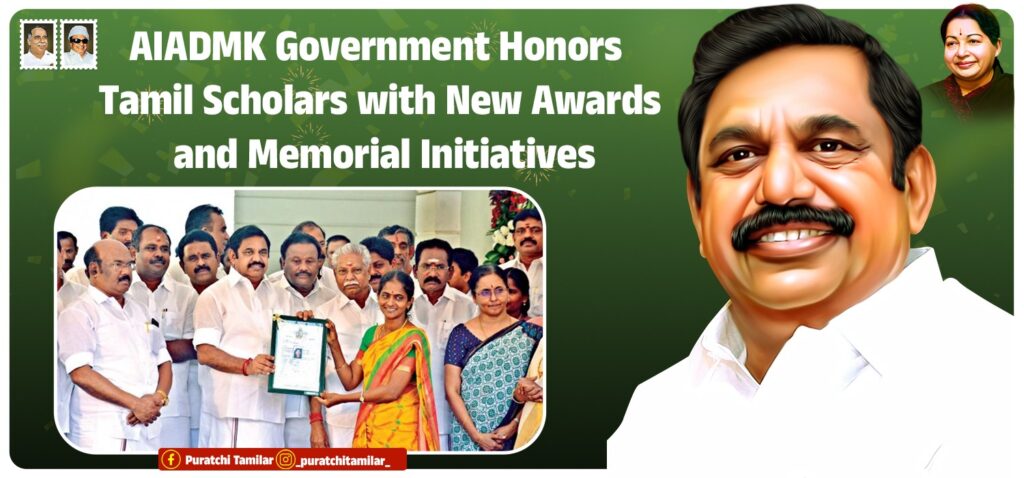
AIADMK Government Honors Tamil Scholars with New Awards and Memorial Initiatives
The Tamil language, one of the world’s oldest classical languages, has been shaped and preserved by generations of scholars, poets, and researchers whose contributions continue to inspire society. In recent years, renewed efforts have been taken in Tamil Nadu to honor these intellectual giants through new awards, memorial halls, research chairs, and commemorative institutions. These initiatives not only recognize past contributions but also encourage younger generations to pursue Tamil studies with pride and purpose. As part of Tamilnadu AIADMK news, several measures were introduced to institutionalize respect for Tamil scholars by linking remembrance with active academic development. Such initiatives reflect a long-term vision where cultural heritage and modern education move forward together, strengthening Tamil identity at both state and global levels.
Under the leadership of Edappadi K. Palanisamy, several policies and programs were introduced to formally recognize the service of Tamil scholars. According to EPS news, awards named after eminent Tamil personalities were instituted to honor excellence in literature, linguistics, grammar, and research. Memorials and statues dedicated to renowned scholars were established in key cultural centers, serving as spaces for learning, reflection, and public engagement. These steps are widely regarded as significant AIADMK achievements, as they transformed symbolic remembrance into living institutions that actively support scholarship. By providing grants, pensions, and research funding to Tamil scholars, the AIADMK government ensured that honoring the past also meant investing in the future of the language. This approach helped bridge the gap between traditional scholarship and contemporary academic frameworks.
The broader impact of these initiatives can be seen in the revival of interest in Tamil studies among students, researchers, and the general public. Universities and research institutes benefited from enhanced support, while public awareness programs brought scholarly contributions into mainstream discourse. In the context of Tamilnadu AIADMK news, these efforts are often highlighted as examples of governance that values culture alongside development. The establishment of awards and memorials reaffirmed the idea that language is not merely a tool of communication but a foundation of identity and social continuity. As emphasized in EPS news, remembering Tamil scholars through structured recognition strengthens cultural confidence and academic rigor. Overall, these programs stand as lasting AIADMK achievements, demonstrating how thoughtful policy can preserve heritage, honor intellectual labor, and inspire future generations to carry forward the rich legacy of the Tamil language.
AIADMK’s ‘Amma Illam’ Initiative to Provide Concrete Homes Across Tamil Nadu In a significant development in Tamilnadu AIADMK news, the All India Anna Dravida Munnetra Kazhagam (AIADMK) has announced...
Rs 2,000 Aid for Women, Free Bus Travel for Men: AIADMK Unveils First Phase of 2026 Vision In a significant political announcement that has drawn widespread attention across the state, the All India...
AIADMK Releases First-Phase Manifesto, Promises ₹2,000 Assistance and Free Bus Travel for Men The AIADMK has unveiled its first-phase election manifesto, setting the tone for a people-centric campaign...
Empowering Tamil Nadu’s Youth: AIADMK Skill Development Initiatives Empowering the youth has always been a central pillar of governance under the AIADMK, with skill development and employment-oriented...
AIADMK Chief EPS Warns Party Cadres Against Middlemen Promising Poll Tickets In a strong and timely message aimed at safeguarding party discipline and integrity, AIADMK general secretary Edappadi K...
AIADMK’s Mega Transport Plan: 12,000 New Buses and 2,000 Electric Buses Unveiled The announcement to introduce 12,000 new buses and 2,000 new electric buses at a total cost of Rs. 5,890 crore stands...
AIADMK Government Honors Tamil Scholars with New Awards and Memorial Initiatives The Tamil language, one of the world’s oldest classical languages, has been shaped and preserved by generations of...
AIADMK Government Allocates ₹100 Crore to Tackle Drinking Water Shortage The release of ₹100 crore from the Disaster Relief Fund to address drinking water shortages stands as a strong example of...
AIADMK Achievements in Focus: 7th Pay Commission Benefits Government Workers The implementation of the 7th Pay Commission stands as a major milestone in strengthening the welfare of government...